
Unlike most bolt-on supercharger systems, which can easily adapt to a variety of vehicles, turbo kits present unique challenges. There is more to contend with in the routing of inlet and outlet tubing between the exhaust manifolds, turbocharger(s), and engine intake. At the minimum, major changes are required of the exhaust system. Of course, all […]
LS ENGINE SUPERCHARGER INSTALLATION PROJECTS
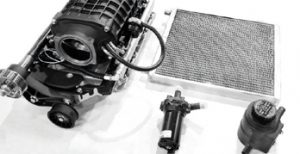
This chapter offers in-depth looks at the two basic types of bolton supercharger systems: Roots/ screw-type compressors that replace the intake manifold and centrifugal systems that mount to the engine’s front accessory-drive system. Both systems are typical in that they are delivered with all of the components and hardware required for installation, including fuel-system upgrades […]
LS ENGINE KIT PRE-INSTALLATION

This chapter discusses peripheral modifications that are commonly performed to support them, including fuel system upgrades, spark plug selection and the process known as “pinning” the crankshaft and balancer. For the most part, the factory cooling system on LS-powered vehicles is sufficient to support bolt-on power adders. In fact, at low speeds and part-throttle conditions, […]
LS TURBOCHARGER TYPES AND HOW TO CHOOSE

Swiss engineer Dr. Alfred Buchi is credited with developing the first exhaust-driven turbocharger, sometime around 1912. By 1915, he published a proposal for employing a turbocharger on a diesel engine, but the idea was mostly ignored for the next few years. The first realworld applications were in aviation, where turbochargers helped aircraft engines build power […]
LS ENGINE SUPERCHARGER TYPES AND HOW TO CHOOSE

Superchargers come in many different shapes and sizes, but they are related by a common attribute: They generate boost pressure via an engine-driven mechanism. Typically, superchargers are driven by a belt connected to the crankshaft. When it comes to the commercially available superchargers for LS engines, there are two basic types: positive displacement and centrifugal. […]
INTRO TO LS ENGINES & FORCED INDUCTION

In general terms, and assuming everything else is equal, an internal combustion engine with larger displacement flows more air than a smaller-displacement engine. The engine with the greater airflow makes more power. This tech tip is from the full book, HOW TO SUPERCHARGE & TURBOCHARGE GM LS-SERIES ENGINES. For a comprehensive guide on this […]
How to Control Your Gen III (3) V-8 LS Engine

If you don’t know how to “slew” a value in an EFI calibration — this article is for you. Here, you will be able to learn the basics of EFI and calibration, and how to take advantage of the advanced Gen III V-8 features like the built-in crank location sensor, cam sensor, and knock sensors. […]
Gen III (3) LS 1200 Horsepower, 387-Cubic-Inch C5R Power Guide

Throughout this book, we’ve T focused on using simple parts and straightforward buildups, but this chapter will show what it takes to build a highly custom, special-use engine. With this engine buildup, you’ll learn many processes to get the multiple systems of a one-off engine working in concert. An engine like this requires considerable time, […]
Gen III (3) LS 500+ Horsepower NA Street-Racer Buildup

If there is any doubt remaining about the power potential of the Gen III LS1/LS6 engine architecture, the following real-world engine buildup should clear that up. Simply put, there is no other production 5.7-liter small-block pushrod V-8 engine design in the world that is as easy to build and responds to a set of race-inspired […]
Gen III (3) LS Vortec Truck Engine Buildup Guide

There are many fans of the iron-block 4.8-, 5.3-, and 6.0-liter Gen III V-8s that power many of the ’99 and later full-size Chevy and GMC trucks. That fan base is drawn to the Gen III V-8 because of its thick powerband, impressive peak power numbers, and good fuel economy. Simply, the Gen III V-8 […]