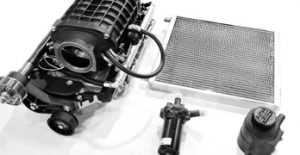
This chapter offers in-depth looks at the two basic types of bolt-on supercharger systems: Roots/ screw-type compressors that replace the intake manifold and centrifugal systems that mount to the engine’s front accessory-drive system. Both systems are typical in that they are delivered with all of the components and hardware required for installation, including fuel-system upgrades […]
LS: Pre-Installation Guide for Turbochargers and Superchargers

This chapter discusses peripheral modifications that are commonly performed to support them, including fuel system upgrades, spark plug selection and the process known as “pinning” the crankshaft and balancer. For the most part, the factory cooling system on LS-powered vehicles is sufficient to support bolt-on power adders. In fact, at low speeds and part-throttle conditions, […]
LS Engine: Intro to Turbocharging and Turbochargers

Swiss engineer Dr. Alfred Buchi is credited with developing the first exhaust-driven turbocharger, sometime around 1912. By 1915, he published a proposal for employing a turbocharger on a diesel engine, but the idea was mostly ignored for the next few years. The first real world applications were in aviation, where turbochargers helped aircraft engines build […]
LS Engine: Intro to Supercharging and Superchargers

Superchargers come in many different shapes and sizes, but they are related by a common attribute: They generate boost pressure via an engine-driven mechanism. Typically, superchargers are driven by a belt connected to the crankshaft. This tech tip is from the full book, HOW TO SUPERCHARGE & TURBOCHARGE GM LS-SERIES ENGINES. For a comprehensive […]
LS Engine: Intro to Forced Induction

In general terms, and assuming everything else is equal, an internal combustion engine with larger displacement flows more air than a smaller-displacement engine. The engine with the greater airflow makes more power. This tech tip is from the full book, HOW TO SUPERCHARGE & TURBOCHARGE GM LS-SERIES ENGINES. For a comprehensive guide on this […]
Ultimate LS Cathedral Port Cylinder Heads Guide

Cathedral port cylinder heads have been mistakenly dismissed by many in LS-series circles for being “old-tech.” However, their thin cross-section allows for a high-velocity and smaller-volume runner design with excellent flow. For a street car, this design means excellent throttle response, torque and average power. Dyno tests have proven that comparable aftermarket cathedral port heads […]
LS Cylinder Blocks Guide for High-Performance

The cylinder block is the foundation the rest of the engine is built upon. If incredibly high horsepower, torque, and RPM are the goal, the needs may surpass the capabilities of even the best factory offerings. This chapter briefly reviews factory and aftermarket offerings, providing the basic engineering and capabilities. While all LS blocks are […]
LS Cylinder Head Supporting Components Guide

Available intake manifolds and rocker arms should also be considered when choosing cylinder heads. It may add to the cost or help save money; it may add to the performance or take away from the performance of the heads. Unlike with other engines, aftermarket does not necessarily mean better. The OEM designs are durable, light, […]
LS Race Port Cylinder Heads Guide

This chapter covers any cylinder head that uses an intake or exhaust flange that is not compatible or consistent with OEM patterns. To put it in more simple terms, a typical set of LSX headers and exhaust manifolds do not bolt up and neither do any LSX intake manifolds. This tech tip is from […]
Ultimate LS Rectangular Port Cylinder Heads Guide

Rectangular port heads boast a clear advantage in the flow department and are ideal for high-RPM, big-cubic-inch, and purpose-built drag racing applications. Factory castings are capable of 360 to 400 cfm when ported properly, which can make it difficult to justify an aftermarket casting. However, aftermarket castings boast designs more suitable for both more extreme […]
- « Previous Page
- 1
- …
- 5
- 6
- 7
- 8
- 9
- 10
- Next Page »